Diary of a Black Private School Girl: My Experience with Racism in My Adolescence
Written by Senam Okpattah
The movie adaptation of the novel, The Hate U Give, will be premiering in October of this year. It tells the story of a 16-year-old girl named Starr Carter who attends an elite private high school in the suburbs but lives in a poor Black neighborhood known as Garden Heights. The death of Starr’s best friend, Khalil, at the hands of a police officer, sparks an uproar in Starr’s community, reinforcing racial tensions and distrust in the police. Starr must grieve the loss of a friend while reconciling the duality of her experience as a Black girl residing in a contrast between her school and home life.
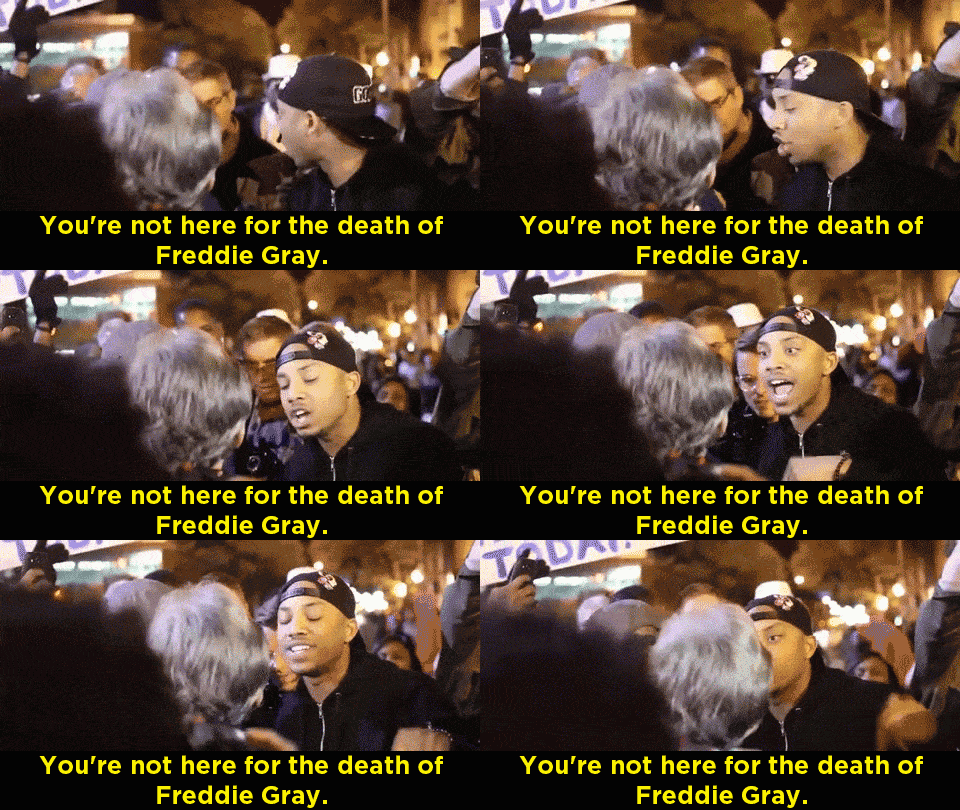
I resonate with Starr Carter and the plot of The Hate U Give because at the age of 17, I too, was forced to reconcile the duality of my own experience. I was a Black inner-city girl attending a predominantly white, private high school and in my junior year, a Black man named Freddie Gray died while in police custody. Gray’s arrest and death occurred minutes away from where I lived and “riots” ensued (I use this term loosely because the protests were heavily sensationalized) within walking distance of my neighborhood.
I attended an all-girls Catholic high school that resides just 20 minutes outside of Baltimore City - a distance close enough for my peers to claim Baltimore as their home but far enough for them to remain oblivious to the very issues that plague the city. My high school was by no means a beacon of diversity as it was both racially and politically homogenous, and for many students, money was no issue. Microaggressions and subtle instances of racism from peers and staff were commonplace and a widespread disregard for the struggles of minorities was also prevalent.
The protests that ensued after Gray’s death sparked the awareness of my Blackness and the greater political context that surrounds it. My understanding of institutional racism prior to the protests only scratched the surface but it was deeper than that of my white peers. I went to school with people that failed to recognize or understand such a staunch political movement. Cries of “black lives matter” were deemed offensive and violent, protesters were referred to as thugs, and the focus of this political action was placed on the ill behavior of a few people rather than the widespread, non-violent efforts of many.
In whispered hushes, white classmates of mine made claims about how they feared that Blacks from Baltimore would terrorize their neighborhoods or cause harm to their families, despite many not living in or near Baltimore. Other students took to Twitter to protest that “all lives matter” and that if Black people, “...didn’t act like thugs, they wouldn’t have to deal with these things.” I became hyper-aware of the not-so-closeted feelings that my white peers held about police brutality and racism.
Many students minimized or invalidated the racial context of police brutality with claims that racism is not a very prevalent issue. They failed to understand that the “riots” were an outcry against police brutality and a generational pattern of racism, violence, injustice, and oppression. Citizens of Baltimore did not want Gray’s life to go in vain and they took to the streets to amplify this message.
I soon realized that I was not awarded the same privileges as my white schoolmates who could disregard racism and or play it off as a non-issue. I had a responsibility to remain attuned to racism and its many facets, not only because I am Black but also because they are issues that impact my community. I learned very quickly that there lies a significant disconnect between the suffering of minority groups and the recognition of this suffering from more privileged classes. At the age of 17, I became of aware of my identity but I also developed an undying urge to protect it by becoming a force of change. Although my time in high school was quite difficult, it made a significant contribution to my development, enabling me to be the person I am today.